


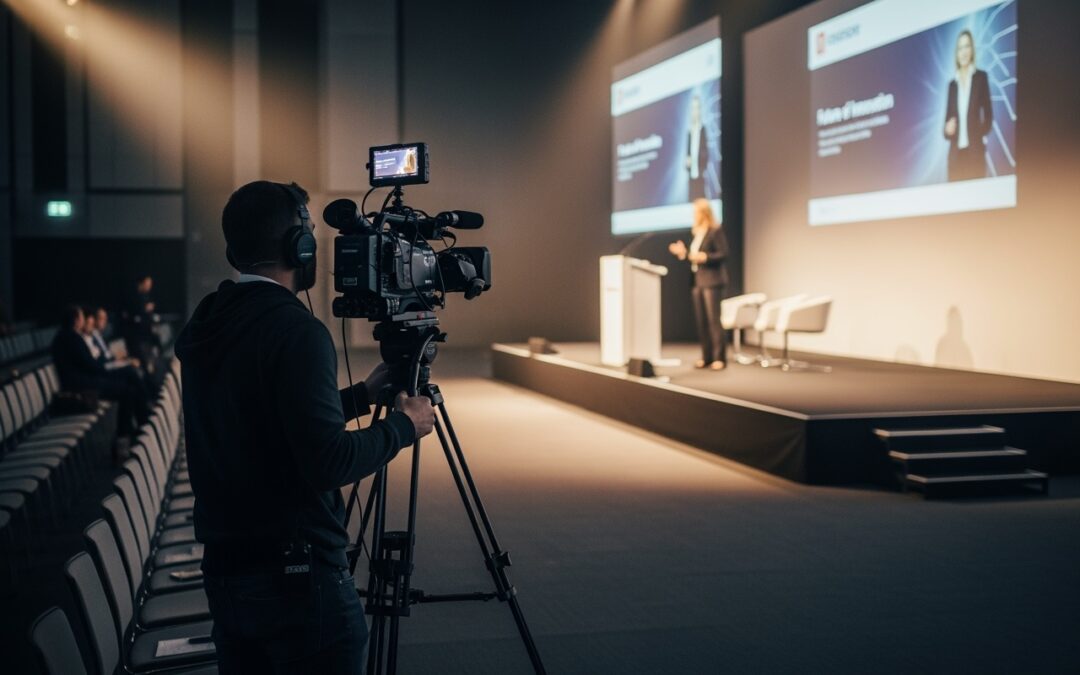
Enterprise events used to operate on a relatively contained delivery model: a ballroom, a stage, an AV team, presenters, and perhaps a recording for later distribution. That model supported a different era of expectations.
Today’s enterprise events function as live communications infrastructure. A product launch may serve in-person attendees, remote customers, internal stakeholders, sales teams, partners, media, and post-event content marketers simultaneously. An executive town hall may be consumed live across multiple geographies while clips are repurposed within hours for downstream communications. Investor-facing events may require broadcast-grade reliability because a technical failure disrupts far more than the audience experience.
The audience has changed. The delivery environment has changed. The operational model has had to evolve accordingly.
How hybrid expectations changed events
Even when organizations stop labeling events as “hybrid,” attendee behavior still reflects hybrid assumptions. Remote participation is expected. On-demand access is assumed. Presentations are increasingly consumed across multiple devices. Audiences expect chat moderation, live polling, rapid replay availability, and clear production quality regardless of the physical location.
That shift changes event architecture at the planning stage. Traditional AV support focuses on the room experience, including projection, sound reinforcement, microphones, lighting, and playback. Hybrid execution introduces a different set of requirements:
- Return video feeds for remote speakers
- Confidence monitoring for presenters
- Webcast latency management
- Bidirectional communications for moderators
- Remote contributor technical validation
- Audience interaction routing between physical and virtual participants
A keynote speaker addressing a room now may also be speaking to thousands of distributed viewers. That changes pacing, presentation design, cueing, and technical execution. The room is no longer the only audience.
Why livestream quality became a performance metric
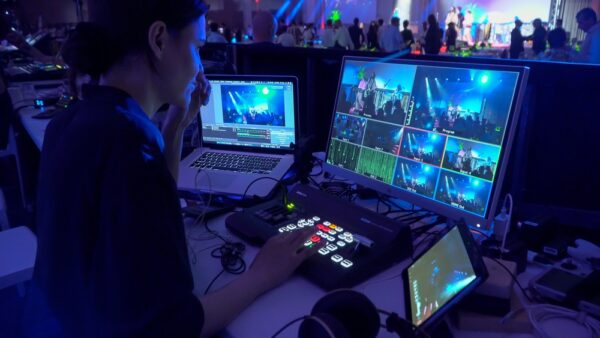
Audiences now compare enterprise livestreams against professional media standards, whether event teams account for that or not. Viewers who routinely consume high-quality streaming platforms have little tolerance for buffering, audio clipping, frozen slides, sync drift, or abrupt feed failures. Any type of failure has real consequences.
If a product announcement stream degrades, viewers disengage. If executive messaging becomes unintelligible because audio levels peak incorrectly, the communication objective collapses. If event clips circulate on social platforms showing production breakdowns, the issue becomes reputational.
Livestream delivery demands engineering oversight, including:
- Redundant encoders
- Upstream bandwidth monitoring
- Adaptive bitrate delivery strategies
- Bonded connectivity for failover resilience
- Audio signal path validation
- Confidence monitoring by dedicated operators
- Playback redundancy
One frequent enterprise failure point is audio routing. Internal event teams may validate in-room sound reinforcement while overlooking livestream feed integrity. The room sounds fine. The remote audience hears distortion.
Different outputs require separate validation. This distinction separates event support from broadcast operations.
Where executive visibility raises production stakes
Enterprise events increasingly serve as executive communications platforms. CEOs deliver strategic updates. Product leaders announce launches. Business units conduct global town halls. Investor communications intersect with live digital delivery.
These scenarios carry different operational expectations than conventional conference presentations. Executive communications often involve:
- Technical rehearsals
- Presentation run-throughs
- Teleprompter integration
- Cue timing support
- Slide version governance
- Standby presentation recovery workflows
- Executive-specific confidence feeds
Executives rarely tolerate improvisational production environments, nor should they. When leadership visibility increases, technical execution becomes organizational risk management.
A delayed executive stream disrupts credibility. A failed town hall affects internal trust. A platform outage during strategic messaging creates operational noise that persists well after the event. The visibility changes the risk equation.
How redundancy became core event infrastructure
Broadcast engineering assumes failure scenarios. Enterprise event planning historically has not always adopted the same mindset. That gap becomes costly. Redundancy now needs to exist across multiple layers:
- Signal redundancy: If the primary switcher fails, is there a backup signal path? If playback hardware crashes, can content be restored immediately?
- Network redundancy: Single uplink dependency introduces unacceptable risk for livestream-heavy enterprise events. Dual ISPs, bonded cellular backup, and tested failover paths are increasingly necessary.
- Audio redundancy: Spare microphones alone are insufficient. Backup mixes, alternate routing, and redundant audio interfaces reduce failure exposure.
- Recording redundancy: Capturing only one master recording path creates unnecessary risk. Parallel ISO and program records protect post-event deliverables.
- Personnel redundancy: Technical infrastructure without staffing redundancy still creates operational fragility. A sick engineer, unavailable TD, or overwhelmed operator introduces avoidable risk.
The most disruptive failures rarely result from catastrophic equipment loss. They emerge at dependency intersections, such as an encoder issue compounded by missing escalation ownership, a remote speaker feed that no one actively monitors, or a playback change introduced without signal validation. Redundancy is an organizational discipline, not merely technical procurement.
Why multi-platform distribution reshaped staffing models
Enterprise event delivery no longer ends when the session concludes. Distribution pathways now frequently include:
- Livestream microsites
- Internal portals
- Gated customer experiences
- Partner distribution environments
- Webinar platforms
- Social media clipping pipelines
- Post-event content hubs
Each distribution channel introduces operational requirements. Streaming engineers manage delivery infrastructure. Digital producers coordinate publishing workflows. Moderation teams support audience interaction. Editors create rapid-turn clips. Analytics teams validate engagement performance.
This creates workforce complexity that traditional event teams were not built to absorb. A ballroom-focused AV crew cannot simultaneously manage livestream monitoring, remote contributor troubleshooting, clipping workflows, attendee digital support, and platform escalation. The staffing model has expanded because the delivery model expanded.

How support functions now extend beyond the event day
Operational support now spans an extended lifecycle.
- Pre-event: Technical rehearsals, remote speaker checks, platform load validation, credential provisioning, content ingest, slide governance, contingency planning
- Live execution: Show calling, livestream monitoring, audience moderation, help-desk response, remote contributor escalation, playback management, feed validation
- Post-event: VOD packaging, access issue support, rapid content clipping, archive delivery, analytics reporting, metadata tagging
The event itself now represents only one operational milestone. Enterprise communications increasingly treat events as content generation engines rather than isolated live moments. This fundamentally changes resource planning.
Where cross-functional coordination becomes a problem
The technical challenge is often manageable. Coordination complexity is harder. Enterprise events frequently involve:
- Internal communications teams
- Marketing leadership
- Corporate IT
- Security stakeholders
- Executive offices
- Creative agencies
- Livestream vendors
- Venue technical teams
- External production partners
Execution risk frequently appears between these teams. Who owns network approvals? Who validates remote presenter readiness? Who controls final slide versions? Who escalates digital platform failures? Who handles executive content changes introduced minutes before showtime? Undefined ownership creates friction.
Broadcast operations solve this through clear command structures, escalation ownership, and disciplined run-of-show governance. Enterprise events increasingly benefit from the same approach.
Why scalable workforce models are better for modern events
Enterprise event demand is uneven. One-quarter may include modest internal meetings. Another may involve simultaneous launches, executive town halls, customer summits, and partner broadcasts. Maintaining permanent fixed teams sized for peak load creates inefficiency. Relying exclusively on ad hoc freelancers introduces inconsistency.
Scalable workforce models offer a better alternative. Pre-vetted technical specialists, embedded production leadership, flexible support teams, and structured escalation frameworks allow organizations to scale without rebuilding operational infrastructure for every initiative. This requires workforce orchestration, instead of simply staffing fulfillment.
Operational continuity depends on role familiarity, technical consistency, and institutional knowledge retained across engagements. The most effective enterprise event teams preserve continuity while maintaining elastic capacity.
How enterprise events operate more like media channels
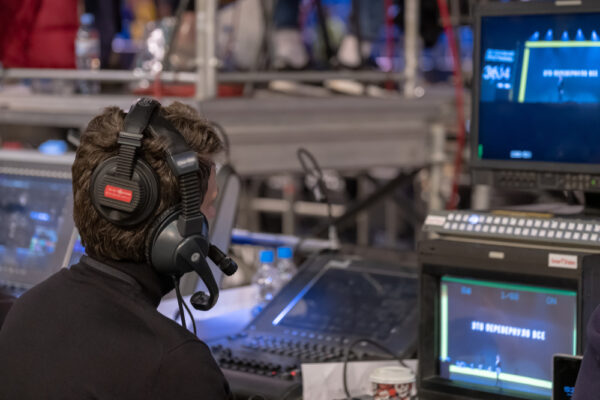
Modern enterprise events increasingly function as owned media properties. They distribute executive communications, generate downstream content, support customer engagement, extend brand visibility, and enable internal alignment. This operational reality calls for delivery models built for resilience, coordination, technical precision, and scalable execution.
Organizations still planning enterprise events as isolated physical gatherings are designing against outdated assumptions. Audience expectations have already moved forward.